
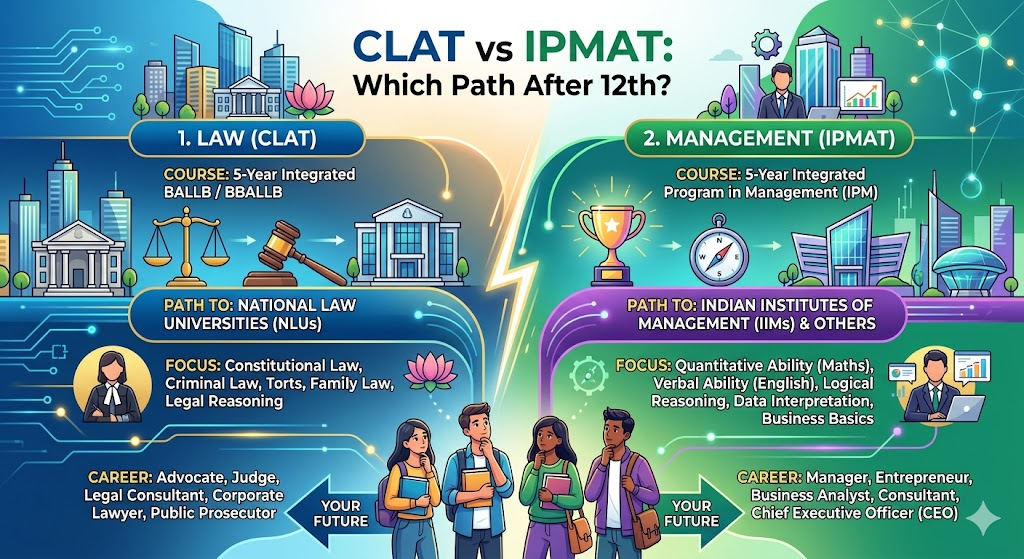

Choosing between CLAT and IPMAT after Class 12 is essentially a difficult choice between two of India’s most prestigious professional entrance exams: Law and Management. While both provide five-year integrated programs offering a direct path to top-tier institutions – NLUs and IIMs, they cater to very different skill sets.
CLAT is a reading-intensive, offline exam that evaluates a student’s legal aptitude, logical reasoning, and comprehension skills, making it ideal for those aiming for careers in the judiciary, corporate law, or litigation. In contrast, IPMAT is a computer-based test with a heavy emphasis on high-level mathematics and verbal ability, designed for students who want to enter the corporate world as management professionals and strategic leaders.
Both paths offer excellent return on investment (ROI) and global career opportunities; the choice depends entirely on whether your strengths lie in analytical reading (Law) or quantitative problem-solving (Management).
If you want to excel in CLAT, join CLAT online coaching by Law Prep Tutorial. With 24+ years of experience in guiding students for law entrance, the coaching provides a flexible learning environment with live classes and recorded sessions.
In case you are an IPMAT aspirant, you should join IPMAT online coaching for structured preparation. Update study material, mock tests and analysis of each, doubt sessions, etc., are a few major benefits of joining LPT IPMAT coaching.
CLAT vs IPMAT: A Comparison
| Features | CLAT | IPMAT |
| Conducted by | Consortium of Laws | IIMs (IIM Indore, IIM Rohtak, etc.) |
| Degree awarded | BA LLB, BBA LLB | Integrated BBA+MBA |
| Duration | 5 years | 5 years |
| Core areas | English, Legal Reasoning, GK, Current Affairs, Quantitative Aptitude | Quantitative Aptitude, Verbal Reasoning, Logical Reasoning |
| Best for | Students seeking a career in law | Candidates interested in management |
| Success rate | ||
| Difficulty level | Moderate to high | Moderate to high (High difficulty level in quant) |
What is CLAT?
The Common Law Admission Test (CLAT) is a national-level entrance exam conducted by the Consortium of NLUs. Through CLAT, admission is offered at 24 NLUs for 5-year undergraduate law programs. Apart from NLUs, admission is also offered at 61 affiliated law colleges spread across India. Unlike IPMAT, CLAT is held offline, and the duration is 2 hours. Some key aspects of CLAT are mentioned below. Chem them out.
| Features | Details |
| Name of the exam | Common Law Admission Test (CLAT) |
| Conducting body | The Consortium of National Law Universities (NLUs) |
| Exam Level | National-level exam |
| Purpose of the exam | -To offer admission to UG law courses at the participating NLU after class 12. -Admissions to Private colleges |
| Question Paper medium | English |
| Exam mode | Offline |
| Exam duration | Two hours |
| Number of seats | For UG courses – 4000+ |
| Accepting colleges | 24 participating NLUs and 61 private law colleges |
| Top-ranked participating NLU | Here are the top-ranking participating NLUs as per NIRF Ranking -NLSIU Bengaluru – Rank 1- NALSAR – Rank 3-WBNUJS Kolkata – Rank 4 |
CLAT Online Coaching by Law Prep Tutorial
Law Prep Tutorial is a reputed law preparation hub in India. This institute has a proven record of producing top rankers in CLAT UG (AIR 1 in 2024 and AIR 1 in 2026). The platform features live interactive classes, mentorship from NLSIU and NALSAR alumni. Their strategic approach includes AI-powered mock analysis, conceptual classes for key topics and more. Check the detailed CLAT online coaching features by Law Prep Tutorial here.
| Feature | Details |
| Program Name | CLAT Online Coaching |
| Mode of Classes | Live Online Classes + Recorded Lectures |
| Faculty’s experience | Experienced law entrance mentors |
| Teaching Style | Live interactive classes with recorded sessions |
| Resources | Comprehensive digital study material |
| Mock Tests | Full-length and sectional mock tests |
| Practice Content | Topic-wise assignments and exercises |
| Previous Year Papers | CLAT Previous Year Papers with solutions |
| Doubt Resolution | Live doubt sessions and support |
| Performance Assessment | Detailed analytics and progress reports |
| Mentorship | Strategy sessions and preparation guidance |
| Revision Support | Recorded lectures for revision |
| Suitable For | Class 11, 12 and dropper students |
| Learning Flexibility | Study anytime with recordings |
| Additional Support | Time management and exam strategy sessions |
What is IPMAT?
Integrated Program in Management Aptitude Test (IPMAT) is a national-level management entrance exam conducted by IIM Indore and IIM Rohtak. This management entrance is for admission 5 year integrated management exams. Through IPMAT, aspiring students can secure seats at IIMs like Indore, Rohtak, Ranchi, Jammu, Bodh Gaya, and other top B-schools. The IPMAT selection process involves an online exam followed by a Personal Interview (PI) round. Check the key aspects of the IPMAT exam mentioned below.
| Features | Details |
| IPMAT full form | Integrated Programme in Management Aptitude Test (IPMAT) |
| Conducting Body | IIM Indore |
| Exam Level | National |
| Exam frequency | Annual |
| Mode | Online |
| Syllabus | Quantitative AbilityVerbal AbilityLogical Reasoning |
| Number of sections | 3 |
| IPMAT exam pattern | Multiple-choice questions (MCQs) & Short Answer Type Questions |
| Marking scheme | 4 marks for correct answers-1 mark for an incorrect answer |
| Language | English |
| Duration of the exam | 2 hours |
| Course/s offered | Integrated Management Programme (Bachelor of Arts (BA) in Foundations of Management and a Master of Business Administration (MBA)) |
| Official website | https://www.iimidr.ac.in/ |
IPMAT Online Coaching by LPT EdTech
LPT EdTech is a premier IPMAT online coaching, specifically designed for IPMAT aspirants. Be it class 11 and 12 grade students or retakers, the coaching provides flexible IPMAT classes to help students manage their schedule effectively. LPT stands out for its high-engagement module suited for students aiming to get into IIM Indore and IIM Rohtak.
| Feature | Details |
| Program Name | IPMAT Online Coaching |
| Mode of Classes | Live Online Classes + Recorded Lectures |
| Learning Mode | Flexible schedule |
| Ideal For | Best for class 12 students managing board exams, retakers |
| Faculty Interaction | Face-to-face interaction |
| Mock Tests | Full-length and sectional mock tests |
| Practice Content | Topic-wise assignments and exercises |
| Previous Year Papers | A detailed analysis of past PYQs with solutions |
| Doubt Resolution | Live doubt sessions and support |
| Performance Assessment | Detailed analytics and progress reports |
| Mentorship | Strategy sessions and preparation guidance |
| Learning Flexibility | Study anytime with recordings |
| Additional Support | Mock interview, sessions on time management and soft skills |
CLAT vs IPMAT: Know Key Differences in Exam Pattern and Syllabus
The significant differences between CLAT and IPMAT are in their pattern and syllabi. While CLAT evaluates candidates’ comprehension ability, IPMAT tests students’ quantitative and logical aptitude. Check the key difference in pattern and syllabus below.
CLAT Exam Pattern and Syllabus
The CLAT syllabus consists of 5 sections: English, Logical Reasoning, Quantitative Techniques, Legal Reasoning and Current Affairs and GK. These section tests students reasoning abilities, legal knowledge and the ability to comprehend the passage analytically. Check the pattern below.
| Features | Details |
| Exam mode | Pen-and-paper mode |
| Exam duration | 2 hours |
| Type of questions | Multiple-Choice Questions (MCQs) |
| Total questions | 150 questions |
| Maximum marks | 150 marks |
| Marking scheme | -1 for correct answer, -0.25 for incorrect answer |
| Test language | English |
IPMAT Exam Pattern and Syllabus
IPMAT is a computer-based test where short-answer-type questions are asked along with MCQs. Unlike CLAT, the IPMAT exam has a sectional time limit; each section is allotted 40 minutes to answer the questions. A total of 90 to 100 questions are asked in the exam. Check the IPMAT pattern below.
| Section | Number of Questions | Time |
| Quantitative Ability (MCQ) | 25 | 40 minutes |
| Verbal Ability (MCQ) | 50 | 40 minutes |
| Quantitative Ability (SA) | 25 | 40 minutes |
| Total | 100 | 120 minutes/ 2 hours |
CLAT vs IPMAT: Career Prospects
For better clarity, students should analyse and compare the career prospects of both exams. Note that both provide lucrative job opportunities and a better scope to grow in the future. Check the key fields you can opt for:
Career path after CLAT: You can work with the top law firms, handling compliance, contract and taxation-related issues. You can also practice in the High Courts or the Supreme Court as a veteran advocate.
Career tracks after IPMAT: After graduating from IIM, you have the opportunity to work in various fields such as consulting firms, marketing and sales, finance and analytics, or you can start your own business using the techniques you learn from your course.
For better insight into it, check the comparison below.
| Aspect | CLAT | IPMAT |
| Field | Law | Business & Management |
| Work Environment | Courts, law firms, corporate legal teams | Corporate offices, startups, consulting firms |
| Career Growth | Experience-based | Performance-based |
| Higher Study Options | LLM, Judiciary, MBA | MBA specialisation, international management |
| Flexibility | Moderate | High across industries |
FAQs on CLAT vs IPMAT
Ques. Which is better, CLAT or IPMAT?
Ans. Neither is objectively “better” as they cater to different career goals; CLAT is the premier route for a career in Law and the Judiciary, while IPMAT is an elite fast-track into Corporate Management. Your choice should depend on whether you prefer reading, logic, and social sciences (CLAT) or high-level mathematics and business strategy (IPMAT).
Ques. Is IPMAT a good career option?
Ans. Yes, it is one of the most prestigious undergraduate options in India, offering a direct entry into IIMs without the pressure of the CAT exam later. It provides an excellent ROI, with top graduates often securing placements in global consulting and finance firms with starting packages exceeding ₹25 LPA.
Ques. What is a good score in CLAT?
Ans. For the 120-mark format, a score of 90+ is generally considered excellent and usually secures a seat in the top 3 National Law Universities (NLUs). A score between 75 and 85 is typically competitive for other top-tier NLUs, though cut-offs vary annually based on the paper’s difficulty level.
Ques. What should the score in IPMAT be for IIM Indore and IIM Rohtak?
Ans. For IIM Indore, a safe score is typically around 180–200+ (out of 360), though clearing individual sectional cut-offs in Math and English is mandatory. For IIM Rohtak, which has a 480-mark paper, a score of 350+ for General category students is usually required to secure an interview call.
Ques. Who is eligible for CLAT?
Ans. Any candidate who has passed the 10+2 (Intermediate) or an equivalent examination with at least 45% marks (40% for SC/ST) is eligible. There is currently no upper age limit for appearing in the CLAT UG exam, making it accessible to students from all streams.
Ques. What is the minimum criterion for IPMAT?
Ans. Candidates must have passed their Class 10 and Class 12 exams with a minimum of 60% aggregate marks (55% for SC/ST/PwD). Additionally, there is an age limit; applicants should typically be no older than 20 years as of the application date (with a 5-year relaxation for reserved categories).