
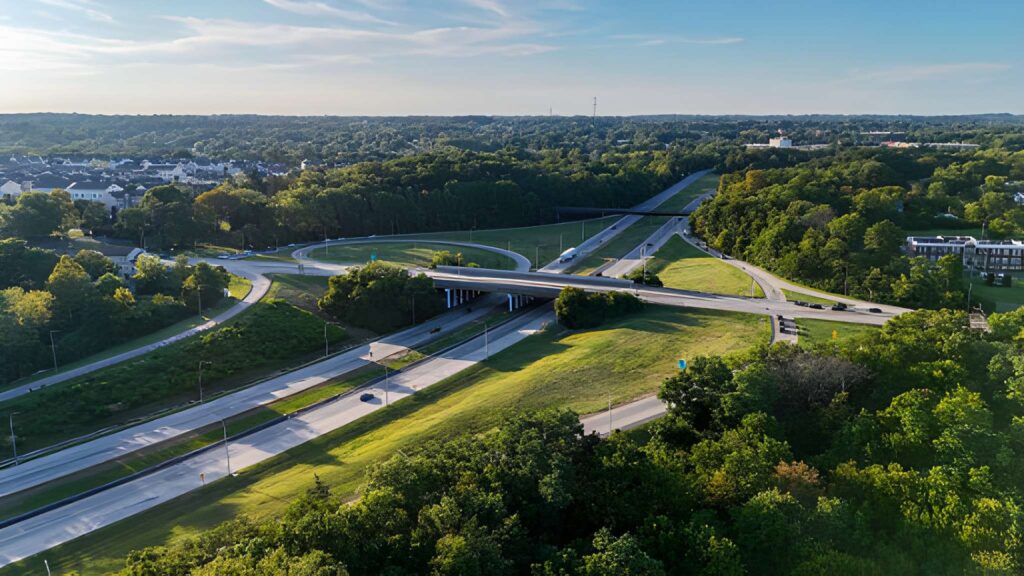

Nashville keeps growing, and with that growth comes a simple, everyday expectation: getting where you need to go without unnecessary delay—and getting there safely. Few corridors carry that responsibility more than IH-24, a critical route for commuters, freight, and regional travel. When an interchange along a major interstate starts to strain under demand, the solution has to be more than a quick fix. It needs smart engineering, careful staging, and rigorous oversight in the field so the finished project performs the way it was intended.
That’s why Pape-Dawson’s team in Nashville is helping support the IH-24 and Hickory Hollow Parkway Interchange Modification project through Construction Engineering Inspection (CEI)—the behind-the-scenes discipline that keeps construction quality, safety, and documentation on track from the first mobilization to final punch list.
A project designed for real-world movement
Interchange projects are complex because they don’t happen in a vacuum. The traffic is still there—morning rush, weekend shopping trips, deliveries, emergency vehicles—moving through the same space where crews are placing concrete, relocating utilities, and shifting lanes. At Hickory Hollow, the construction scope reflects the kind of comprehensive improvement Nashville infrastructure demands: bridge work, ramp modifications, earthwork, drainage, paving, and the systems drivers rely on every day, like signals, lighting, signage, and intelligent transportation systems (ITS).
The work includes widening an interstate overpass bridge, constructing new bridge elements, modifying ramps, building retaining walls, improving utilities, and implementing drainage and stream-related work where required. On the roadway side, the improvements expand Hickory Hollow Parkway from its existing configuration into broader 4-lane and 6-lane segments depending on the section, using the right median or turn-lane strategy for the area. The project also introduces new connectivity tied to nearby parkway access and interchange operations, supporting evolving development and travel patterns.
One notable feature is the planned use of a modified diverging diamond configuration at the ramp terminal area—an approach increasingly used nationwide to reduce conflict points and improve traffic flow through busy interchange intersections. In practice, the value is straightforward: fewer confusing merges, clearer movements, and a safer, more predictable drive for everyone using the corridor.
What CEI really means on a job like this
CEI is sometimes described as “inspection,” but on major transportation projects, it’s far more than a checklist. It’s the daily, methodical process of making sure what’s being built matches what was designed—while tracking quantities, verifying materials, reviewing installation methods, and documenting progress in a way that protects the owner, the contractor, and the public.
For the IH-24 / Hickory Hollow project, Pape-Dawson’s CEI involvement covers broad administrative and records responsibilities across the job, plus detailed field oversight such as:
- Inspection and materials testing for retaining walls
- Inspection and materials testing for new bridge construction
- Inspection and materials testing for bridge widening over IH-24
- Earthwork inspection and survey quantity verification
- Verification of drainage structure installation
- Inspection support for ITS improvements
This kind of scope requires both technical rigor and steady coordination. Bridge and wall systems must meet structural expectations. Drainage has to function in all seasons, not just on a dry-day walk-through. ITS components must be installed and integrated properly so the corridor operates smoothly when lanes shift and traffic volumes surge. And throughout the process, documentation matters—because public infrastructure is built to standards that must be traceable, auditable, and dependable.
Built for Nashville: local expertise with a field-first mindset
Large projects succeed when the team understands the region, the corridor, and the daily realities of construction in an active urban environment. Pape-Dawson’s Nashville presence brings a local foundation and the capacity to support complex transportation work—from field verification to coordination across stakeholders.
When you zoom out, interchange improvements like this one do more than serve drivers. They support freight reliability, improve emergency response access, and help reduce the kind of stop-and-go conditions that raise risk and frustration. They also create room for Nashville’s future growth by modernizing key links between interstate travel and developing commercial and residential areas.
Keeping the public moving while the work gets done
A hallmark of well-run transportation construction is that most people only notice the inconvenience—not the orchestration behind it. Lane shifts, temporary pavement, overnight closures, staged ramp work, and incremental changes to traffic patterns all require careful sequencing. CEI helps ensure those phases are implemented safely, with the right materials, the right geometry, and the right attention to detail so that each stage sets up the next without rework.
That’s what makes Pape-Dawson’s role valuable here: the steady, day-to-day focus on build quality and compliance that turns a complicated construction site into a finished interchange people can rely on.
And while this project is firmly rooted in construction oversight, it also fits into the larger picture of how Nashville evolves—where roadway performance, land use, and mobility goals intersect. In that broader context, the interchange work complements the region’s transportation planning services Nashville, Tennessee stakeholders depend on to keep growth aligned with safe, efficient movement.
Pape-Dawson NAP (Nashville)
- Name: Pape-Dawson
- Address: 315 Woodland Street, P.O. Box 60070, Nashville, TN 37206
- Phone: (615) 244-8591
- Website: https://www.pape-dawson.com/